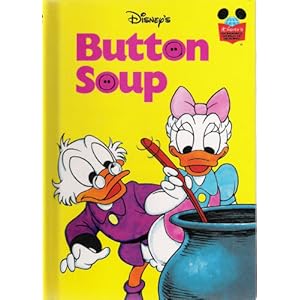
Button Soup was one of my favorite childhood books. If you look at my copy it is quite "used". We found it first at Goodwill and then happy brought it into our own collection. Button Soup is Disney's spin on the classic tale of Stone Soup. Daisy comes into town to see her uncle Scrooge and tells him that she can make soup with only a single button. She tricks Scrooge into relieving his secret stash of food and include it into the soup.
The story itself can be a story in sharing with the people around you. However, in the story, Daisy does use deception to get her Uncle Scrooge to share his many possessions. That being said, even though Scrooge is tricked into sharing his food, he does feel good about sharing in the end.
The book's illustrations are done in a watercolor style. This could be integrated into an art class with watercolor paints. Younger students could even watercolor coloring book pages (possibly Disney) if they did not sketch their own drawings.
Wednesday, September 26, 2012
Wednesday, September 19, 2012
Day of the Dead
Day of the Dead, by Tony Johnston and illustrated by Jeanette Winter, is a delightful story about a family's routine during their Day of the Dead traditions. The story begins at sunrise and ends when the sun falls. When I picked up this book at the UNM library I knew that it was going to be good as soon as I read the first page. The page reads "Above a small town in Mexico, the sun rises like a great marigold." The text is accompanied by a large bright marigold as a sun peaking over cool toned houses in a small town's skyline. The combination of text and illustration immediately drew me in!
Personally, I love Día de los Muertos, or Day of the Dead celebrations here in New Mexico. My family and I always go down to the Dia de los Muertos parade down on Rio Grande to celebrate. I would even consider bringing a small class to the parade to enjoy some of the festivities.
This book would be perfect for a classroom in New Mexico to teach students some cultural traditions that are celebrated in New Mexico that they may not be aware of. Learning about this tradition gives students an excellent chance to talk about how other cultures view afterlife (a great discussion for older classrooms). The holiday is also accompanied by wonderful food and art. This could easily be brought into the classroom. For example, the book mentions tamales, empanadas, mole, and sugar skulls, among many others.
This book itself also has absolutely beautiful illustrations. The book is a small square. Each page has a central illustration that tells the story of the text, but around this image is a boarder featuring repetitive images of the main theme of the page. That sounds a little conveluted, I know, but if you check out this book it will make WAY more sense and I guarantee that it's pretty awesome.
And! Oh my goodness did I hit the jackpot online! I found a unit (group of lessons) that is centered around Day of the Dead traditions where the first lesson includes reading this book. It was created in partnership with Denver Public Schools and Metropolitan State College in Denver.
here's the link!
http://www.dpsk12.org/programs/almaproject/pdf/ElDiadelosMuertos.pdf
Wednesday, September 12, 2012
One fish two fish red fish blue fish
This week I decided to read a classic! I read Dr. Seuss' One fish two fish red fish blue fish quite a lot when I was little, and my dad would read it to me as a bed time story. This, like Mike Mulligan and His Steam Shovel, is one of my Dad's favorites.
This book fits into the genre of both picture book and poetry. The book relies heavily on the pictures and follows a poetic rhythm and rhyme.
This Dr. Seuss classic would be a great lesson in opposites. For instance, one page says:
We see them come.
We see them go.
Some are fast.
And Some are slow.
Some are high.
And some are low.
Not one of them is like another.
Don't ask us why.
Go ask your mother.
In addition to the text, the pictures on this page help illustrate the differences between these opposites.
Here is a worksheet on opposites provided by seussville.com
Other excerpts of the book could help students with rhyming words. One section of the book reads:
This one,
I think,
is called
a Yink.
He likes to wink,
he likes to drink.
He likes to drink, and drink, and drink.
The think he likes to drink
is ink.
The ink he likes to drink is pink.
He likes to wink and drink pink ink.
SO . . .
if you have a lot of ink,
then you should get
a Yink, I think.
One fish two fish red fish blue fish is also shares a great lesson to it's readers, that everyone is different and that differences should be celebrated. Much of the book simply points out differences, but one page in particular stands out to me for giving this idea of celebration.
Say!
Look at his fingers!
One, two, three . . .
How many fingers
do I see?
One, two, three, four,
five, six, seven,
eight, nine, ten.
He has eleven!
Eleven!
This is something new.
I wish I had eleven too!
Wednesday, September 5, 2012
Mike Mulligan and His Steam Shovel
I was at Big Lots with my Dad last week and the two of us started to look through their children's books. I was skimming through the books, looking for one to catch my eye, and my dad excitedly pulled out a little red book and handed it to me. It was called Mike Mulligan and His Steam Shovel. My dad began to tell me that it was one of his favorite books as a child, so I had to check it out.
Mike Mulligan and His Steam Shovel is about a man who runs a steam shovel for a living. He is very proud of his work. Over the years, technology advances and his services are no longer in demand. While struggling to find work Mike and his steam shovel Marry Anne hear that the small town of Popperville needs a new town hall built. Mile and Marry Anne decide to go to Popperville and help the town. I don't want to give away the ending, but it does have an interesting twist at the end!
This book was written in 1939, so it has a different feel than a lot of newer books. It's illustrations are not flashy or computer generated. It is just an honest story about finding a place in the world for yourself, and the transition of old to new technology.
Here are some neat worksheets I found for grade levels K-3!
"The reproducible worksheets offer practice with various writing modes including prewriting strategies, math skills such as estimation, reading strategies, and dictionary, map, and diagramming skills."
Here's a video of a dad reading Mike Mulligan and His Steam Shovel to his son as a bed time story.
Subscribe to:
Comments (Atom)