
Sunday, November 18, 2012
Thank You, Sarah: The Woman Who Saved Thanksgiving
I had never heard of Sarah Hale until I read this book, which is actually kind of sad. She is an important figure in American history. She was the women that pushed for the validation of Thanksgiving as an American holiday. This book has a light hearted feel and tone while still offering historical context for students. The illustrations are also highly detailed and intriguing. They are highly stylized. Even though much of the book has a fairly brown color palate, it is still very eye catching. I would use this book for elementary age students near thanksgiving.

Wednesday, November 7, 2012
How to Care for Your Monster

How to Care for Your Monster by Norman Bridwell is an older book. It was written in 1970, and I believe my copy is just about that old. The book is structured as a "how to" book for children describing all they need to know when caring for their monster. It is similar to if it was describing how to care for a dog or other pet. The first page of the book tells it all.
"So you want to own a monster? Many people do these days.
You can bring a monster into your home. It's just a matter
of finding one you like.
This book will tell you how to get your monster, and how to
keep him healthy and happy."
This book would be good for 3rd grade readers or lower level 4th grade level readers. It is broken up into small chapters describing each monster. The language, as a whole, is not terribly difficult to grasp. However, there is some touch vocabulary included. For example, in the vampire section, it reads "Vampires are very dignified and polite. But they have rather peculiar habits of eating and sleeping."
I would have this book in my classroom library for students to pick up and read for pleasure. I would also encourage the students to read it during the Halloween season. You could also make a project where students imagine their own monster and write a "how to" story about caring for their monster. I would have the students type their story and then draw a picture of their monster by hand.
Thursday, November 1, 2012
The Berenstain Bears' Nature Guide
The Berenstain Bears' Nature Guide by Stan and Jan Berenstain is a wonderful book. The cover of the book says "Everything small bears and kids need to know about the wonderful world of Nature." This is exactly what this book has to offer! It goes over ideas senses, how to identify is something is an animal, animal reproduction, birds, the life cycle of a frog, different kinds of plants, and caves! I would use this book in my class to introduce biology lessons to my class as an introduction. I would use certain sections here and there when they went with my lesson. 
Wednesday, October 24, 2012
The Snowy Day

The Snowy Day by Ezra Jack Keats is a Caldecott winner. The book has beautiful artwork. It is quite simplistic, but very effective for the clean simplicity for the book.

The story recounts a boy Peter's day of adventure in the snow. I enjoyed this story because it is an incredibly happy and pleasant realistic fiction book. The book does not really have an antagonist, which could lead you to assume that it is without substance, but this is not the case. This book shows, realistically, that some days there are no antagonists and they are just good. I think this is an important idea to share with students.
Here is a lesson plan for very young students just starting to learn about different types of weather that uses The Snowy Day.
http://www.scholastic.com/teachers/lesson-plan/snowy-day-lesson-plan
Wednesday, October 17, 2012
The Very Hungry Caterpillar
I think most people are aware of Eric Carl's The Very Hungry Caterpillar. This book is classically used in younger classrooms to teach subjects such as days of the week, types of fruit, numbers, or the life cycle of a butterfly.
During my book talk, I posed the question "how could this book be used with students in older grades?" to my group. The idea of using this book as an art project was brought up. Students could do a project that involved paper tearing artwork. But the most interesting idea was to use the book for teaching other languages to your students. The basic vocabulary such as food and days of the week is perfect to use when working on beginning level foreign language learning. While reading the book to your class you could have your students translate these words in Spanish for instance. We also spoke about using this book to help teach sign language vocabulary to your students.
During my book talk, I posed the question "how could this book be used with students in older grades?" to my group. The idea of using this book as an art project was brought up. Students could do a project that involved paper tearing artwork. But the most interesting idea was to use the book for teaching other languages to your students. The basic vocabulary such as food and days of the week is perfect to use when working on beginning level foreign language learning. While reading the book to your class you could have your students translate these words in Spanish for instance. We also spoke about using this book to help teach sign language vocabulary to your students.
Tuesday, October 2, 2012
The Gardener Book Talk!
The Gardener, by Sarah Stewart and illustrated by David Small, is a Caldecott honor book. I was immediately drawn to it at the bookstore because of its beautiful illustrations. Small depicts a garden as a fantasy like oasis, but keeps its small imperfections. For example he takes the time to draw small scattered weeds into the pages and refrains from putting all the plants in sterile uniform rows. This gives the book a more honest and organic feel.
The story itself is told in the form of letters from the main character, Lydia Grace, to her Uncle Jim or to her parents, in the 1930's. Lydia moves away from her parents care to live with her uncle until her father finds work. At home Lydia Grace is an amazing gardener and uses gardening as a way to express herself. When she moves to the city, and begins working at her summer bakery, she devises a plan to share her beloved plants with the city and Uncle Jim.
The Gardener is a great story, exemplifying the idea that even the smallest gesture can mean the world. It also shows that when you come into a new space, it is important to learn from the locals but also share what you know and love from previous experiences.
I would recommend The Gardener for any classroom K-12. It can be used to teach genre, story telling, reading comprehension, vocabulary, history, and more to your students.

The story itself is told in the form of letters from the main character, Lydia Grace, to her Uncle Jim or to her parents, in the 1930's. Lydia moves away from her parents care to live with her uncle until her father finds work. At home Lydia Grace is an amazing gardener and uses gardening as a way to express herself. When she moves to the city, and begins working at her summer bakery, she devises a plan to share her beloved plants with the city and Uncle Jim.
The Gardener is a great story, exemplifying the idea that even the smallest gesture can mean the world. It also shows that when you come into a new space, it is important to learn from the locals but also share what you know and love from previous experiences.
I would recommend The Gardener for any classroom K-12. It can be used to teach genre, story telling, reading comprehension, vocabulary, history, and more to your students.
take me out of the bathtub and other silly dilly songs

Take me out of the bathtub and other silly dilly songs is an interesting book. It is a book of songs written to the tunes of familiar songs put to different lyrics. The main song, also the title, is take me out of the bathtub. Its sung to the tune of Take Me Out to the Ballgame. Below is a video two girls singing the song from the book.
Even though the book alone is not incredibly entertaining, some of the individual songs are quite clever. For instance, I enjoyed the "take me out of the bathtub" song above. If you choose to use this book in your classroom, I would suggest using it in segments, rather than as an entire work. In a classroom, students could learn the songs themselves to sing together. You could even have your students create their own lyrics to songs of your or their choice. This can either be tailored to a specific subject matter, or the choice in subject matter can be up to the students to choose.
Wednesday, September 26, 2012
Button Soup
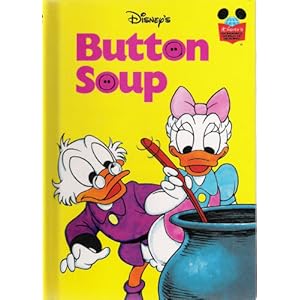
The story itself can be a story in sharing with the people around you. However, in the story, Daisy does use deception to get her Uncle Scrooge to share his many possessions. That being said, even though Scrooge is tricked into sharing his food, he does feel good about sharing in the end.
The book's illustrations are done in a watercolor style. This could be integrated into an art class with watercolor paints. Younger students could even watercolor coloring book pages (possibly Disney) if they did not sketch their own drawings.
Wednesday, September 19, 2012
Day of the Dead

Day of the Dead, by Tony Johnston and illustrated by Jeanette Winter, is a delightful story about a family's routine during their Day of the Dead traditions. The story begins at sunrise and ends when the sun falls. When I picked up this book at the UNM library I knew that it was going to be good as soon as I read the first page. The page reads "Above a small town in Mexico, the sun rises like a great marigold." The text is accompanied by a large bright marigold as a sun peaking over cool toned houses in a small town's skyline. The combination of text and illustration immediately drew me in!
Personally, I love Día de los Muertos, or Day of the Dead celebrations here in New Mexico. My family and I always go down to the Dia de los Muertos parade down on Rio Grande to celebrate. I would even consider bringing a small class to the parade to enjoy some of the festivities.
This book would be perfect for a classroom in New Mexico to teach students some cultural traditions that are celebrated in New Mexico that they may not be aware of. Learning about this tradition gives students an excellent chance to talk about how other cultures view afterlife (a great discussion for older classrooms). The holiday is also accompanied by wonderful food and art. This could easily be brought into the classroom. For example, the book mentions tamales, empanadas, mole, and sugar skulls, among many others.
This book itself also has absolutely beautiful illustrations. The book is a small square. Each page has a central illustration that tells the story of the text, but around this image is a boarder featuring repetitive images of the main theme of the page. That sounds a little conveluted, I know, but if you check out this book it will make WAY more sense and I guarantee that it's pretty awesome.
And! Oh my goodness did I hit the jackpot online! I found a unit (group of lessons) that is centered around Day of the Dead traditions where the first lesson includes reading this book. It was created in partnership with Denver Public Schools and Metropolitan State College in Denver.
here's the link!
http://www.dpsk12.org/programs/almaproject/pdf/ElDiadelosMuertos.pdf
Wednesday, September 12, 2012
One fish two fish red fish blue fish

This week I decided to read a classic! I read Dr. Seuss' One fish two fish red fish blue fish quite a lot when I was little, and my dad would read it to me as a bed time story. This, like Mike Mulligan and His Steam Shovel, is one of my Dad's favorites.
This book fits into the genre of both picture book and poetry. The book relies heavily on the pictures and follows a poetic rhythm and rhyme.
This Dr. Seuss classic would be a great lesson in opposites. For instance, one page says:
We see them come.
We see them go.
Some are fast.
And Some are slow.
Some are high.
And some are low.
Not one of them is like another.
Don't ask us why.
Go ask your mother.
In addition to the text, the pictures on this page help illustrate the differences between these opposites.
Here is a worksheet on opposites provided by seussville.com
Other excerpts of the book could help students with rhyming words. One section of the book reads:
This one,
I think,
is called
a Yink.
He likes to wink,
he likes to drink.
He likes to drink, and drink, and drink.
The think he likes to drink
is ink.
The ink he likes to drink is pink.
He likes to wink and drink pink ink.
SO . . .
if you have a lot of ink,
then you should get
a Yink, I think.
One fish two fish red fish blue fish is also shares a great lesson to it's readers, that everyone is different and that differences should be celebrated. Much of the book simply points out differences, but one page in particular stands out to me for giving this idea of celebration.
Say!
Look at his fingers!
One, two, three . . .
How many fingers
do I see?
One, two, three, four,
five, six, seven,
eight, nine, ten.
He has eleven!
Eleven!
This is something new.
I wish I had eleven too!
Wednesday, September 5, 2012
Mike Mulligan and His Steam Shovel

I was at Big Lots with my Dad last week and the two of us started to look through their children's books. I was skimming through the books, looking for one to catch my eye, and my dad excitedly pulled out a little red book and handed it to me. It was called Mike Mulligan and His Steam Shovel. My dad began to tell me that it was one of his favorite books as a child, so I had to check it out.
Mike Mulligan and His Steam Shovel is about a man who runs a steam shovel for a living. He is very proud of his work. Over the years, technology advances and his services are no longer in demand. While struggling to find work Mike and his steam shovel Marry Anne hear that the small town of Popperville needs a new town hall built. Mile and Marry Anne decide to go to Popperville and help the town. I don't want to give away the ending, but it does have an interesting twist at the end!
This book was written in 1939, so it has a different feel than a lot of newer books. It's illustrations are not flashy or computer generated. It is just an honest story about finding a place in the world for yourself, and the transition of old to new technology.
Here are some neat worksheets I found for grade levels K-3!
"The reproducible worksheets offer practice with various writing modes including prewriting strategies, math skills such as estimation, reading strategies, and dictionary, map, and diagramming skills."
Here's a video of a dad reading Mike Mulligan and His Steam Shovel to his son as a bed time story.
Subscribe to:
Comments (Atom)